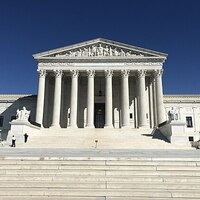


WASHINGTON (CN) - After their unexplained order was met with differing conclusions, the Supreme Court on Thursday clarified that several migrants being held by the U.S. in Djibouti could be deported to South Sudan.
The conservative supermajority allowed President Donald Trump to skip procedural hurdles assessing whether migrants would be harmed or tortured in so-called third-country deportations - when the government sends migrants to countries they don't originate from.
However, multiple lower court rulings stemming from Trump's defiance of a previous preliminary injunction created confusion on how to apply the justices' ruling.
Justice Sonia Sotomayor added to the uncertainty, writing in dissent that the ruling didn't apply to migrants in Djibouti. The Barack Obama appointee argued the court only limited classwide relief to migrants facing third-country deportations, not the secondary lower court ruling specifically barring several individuals from deportation to South Sudan.
"Even if the Government is correct that classwide relief was impermissible here, it plainly remains obligated to comply with orders enjoining its conduct with respect to individual plaintiffs," Sotomayor wrote in a dissent joined by Justices Ketanji Brown Jackson and Elena Kagan.
The majority did not dispute Sotomayor's view that the order was limited. U.S. District Judge Brian Murphy later ruled the migrants couldn't be immediately deported to South Sudan, leaving them stranded in Djibouti.
The dispute is part of Trump's broader effort to deport migrants to dangerous places like Libya or El Salvador's mega-prison without due process. The Supreme Court had repeatedly upheld migrants' rights to these protections in multiple rulings early on in Trump's second term.
A group of migrants filed a class action in late March challenging the Department of Homeland Security's failure to provide meaningful notice and an opportunity to present relevant fear-based claims before removal to a third country.
On April 18, Murphy certified a nationwide class for migrants facing third-country deportation, expanding protections beyond the case's named plaintiffs. He ordered the administration to provide due process before such removals- the preliminary injunction, Sotomayor said, the court later blocked.
Trump, however, tried to advance multiple third-country deportations without due process in the following months, including to El Salvador, Libya and Saudi Arabia.
In May, Murphy issued an emergency restraining order after reports that the administration planned to deport migrants to South Sudan. Sotomayor said the Supreme Court didn't block this ruling because it applied to individual plaintiffs, not the preliminary injunction for the migrant class.
Trump returned to the Supreme Court, accusing Murphy of violating the Supreme Court.
"The district court's ruling of last night is a lawless act of defiance that, once again, disrupts sensitive diplomatic relations and slams the brakes on the Executive's lawful efforts to effectuate third-country removals," U.S. Solicitor General John Sauer wrote.
Source: Courthouse News Service